
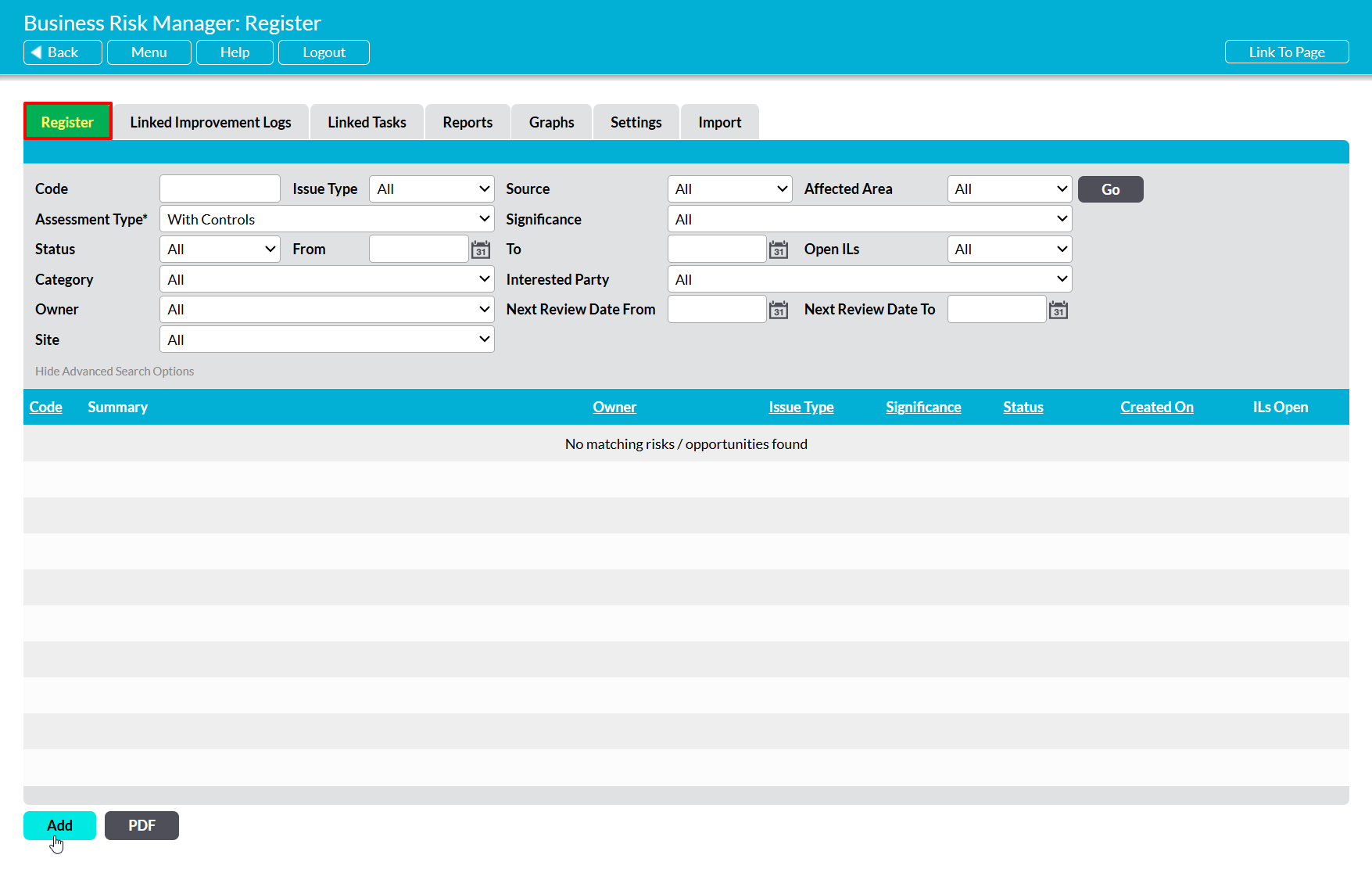
To add a new Risk/Opportunity, open the Business Risk Manager module on its Register. This will display a list of all Issues that are currently recorded within your system.
Click on the Add button.
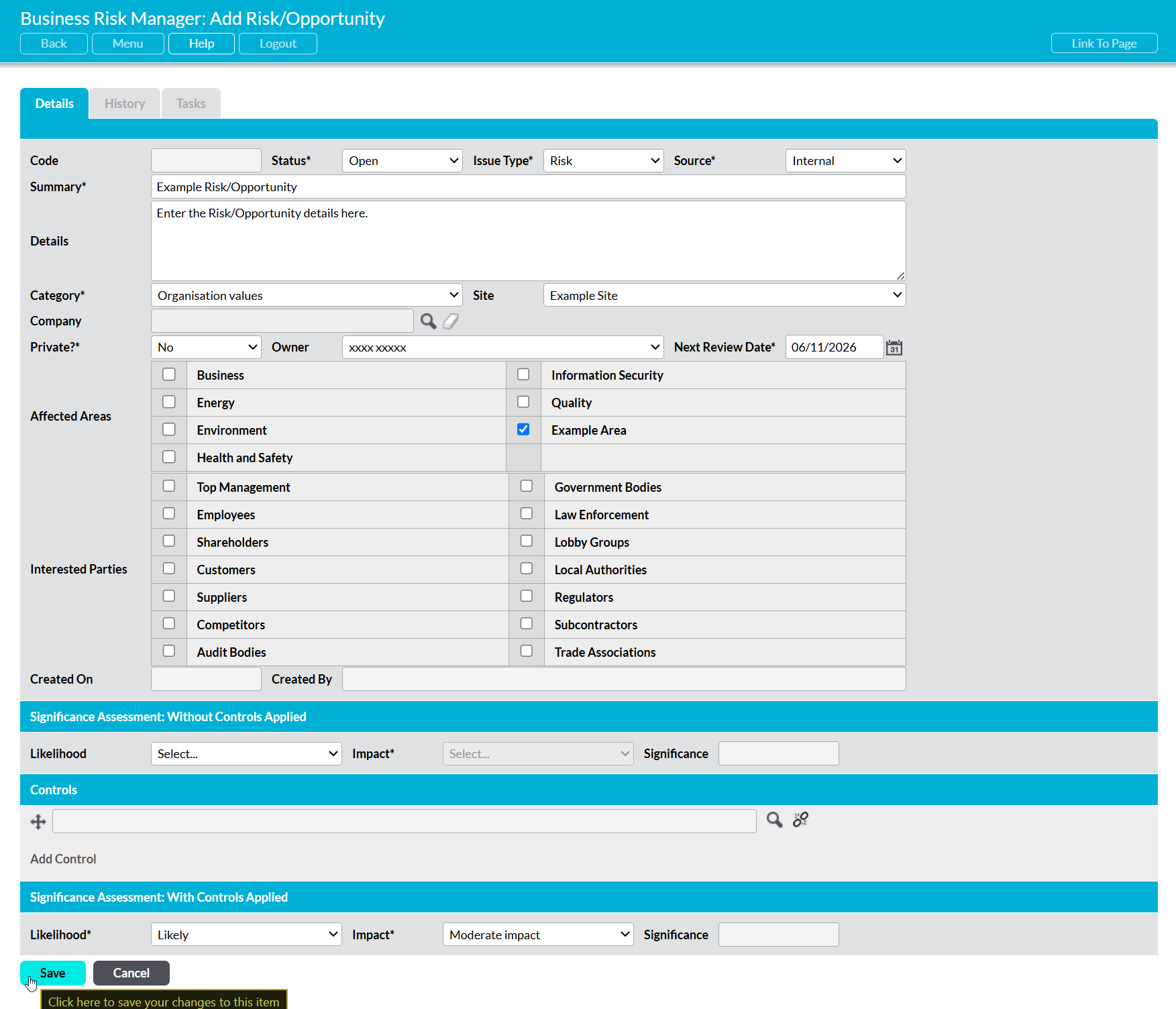
A new Details form will be opened for you to populate. Up to eighteen fields will be available for you to complete, depending on the modules that are included within your system:
Code – unique identification number for each Issue that is recorded within your system. Note that these are automatically generated in sequence, and cannot be changed.
Status* – the current Status of the Issue. New Issues are automatically marked as ‘Open’, but you can update this using the dropdown menu if required.
Issue Type* – use the dropdown menu to specify whether you are raising a Risk or an Opportunity. Note that this will impact the options available within the Significance Assessment sections of the form.
Source* – use the dropdown menu to specify whether the Issue’s source is Internal (i.e. caused by something within your organisation) or External (i.e. caused by something outside of your organisation).
Summary* – enter a short description of the Issue (e.g. a brief summary of what the Risk/Opportunity pertains to).
Details – enter a detailed description of the Risk/Opportunity that is being raised, including any relevant details that may support the Opportunity or impact the Risk. Note that this field is self-expanding, and will allow several paragraphs to be entered if required.
Category* – use the dropdown menu to specify the Category of Issue that is being raised. Note that this field can be configured through your module’s Settings tab (see Configure Business Risk Manager Settings).
Company – only available if your system includes the Customers and Suppliers module. If required, use the magnifying glass icon to select the Company that generates or relates to this Issue.
Private? * – use the dropdown menu to specify whether this Issue should be Public (the default) or Private. Select ‘Yes’ if you wish to restrict access to specific users of the system. Note that this will override normal System Permissions, hiding the record from anyone who isn’t explicitly given access to the Issue (see Restrict Access to a Business Risk/Opportunity).
Owner – optionally, use the dropdown menu to specify the user who has overall responsibility for managing the Risk/Opportunity. Note that this individual must have an Activ user account: you cannot assign an owner who is not already set up within your system. Also note that, providing they have enabled the appropriate Notification settings (see Business Risk Manager Alerts and Reminders), the selected Owner will automatically be notified that they have been assigned Ownership of the Issue.
Next Review Date* – only available if a user has been specified within the Owner field. Use the calendar icon to specify the date on which the Issue should next be Reviewed (i.e. to confirm whether it is still relevant, and make any necessary updates to the record’s content). Note that the specified owner will automatically be notified of upcoming Issue Reviews if they have the appropriate Notification settings enabled (see Business Risk Manager Alerts and Reminders).
Affected Areas – use the tick boxes within this section to specify the Area(s) that are affected by the Issue. Note that the options presented within this section can be configured through your module’s Settings tab (see Configure Business Risk Manager Settings).
Interested Parties – use the tick boxes within this section to specify the Interested Party or Parties that are associated with the Issue. Note that the options presented within this section can be configured through your module’s Settings tab (see Configure Business Risk Manager Settings).
Created On – automatically populated with the date on which the Issue was initially entered into Activ.
Created By – automatically populated with the name of the user who entered the Issue into Activ.
Significance Assessment: Without Controls Applied – an optional section that allows you to assess what an Issue’s Significance Rating is likely to be if no Controls are applied to support or mitigate it. The section consists of three fields:
- Likelihood – use the dropdown to specify the Likelihood of the Risk/Opportunity occurring if no Controls are applied to mitigate/support it. Note that this field can be configured through your module’s Settings tab (see Configure Business Risk Manager Settings).
- Impact – use the dropdown menu to specify the likely Impact that the Risk/Opportunity will have on your organisation if it should occur, and there are no controls in place to mitigate/support it. Note that this field can be configured through your module’s Settings tab (see Configure Business Risk Manager Settings).
- Significance – automatically calculated as ‘Low’, ‘Medium’, or ‘High’ using the above fields and the methodology outlined within the Business Risk/Opportunity Significance Ratings – Calculation Methodology
Controls – an optional section that allows you to record the Controls that you have in place to manage the Risk or capitalise on the Opportunity. Click on Add Control within this section to add:
- records stored within your File Manager, Improvement Logs, and/or Processes modules (if they are included in your package);
- individual Companies (if your system includes Customers and Suppliers);
- individual Employees;
- attachments; and/or
- external URLS.
Note that you can also use the External Resources option within this area to add a text description of the Control if required. This text can be added into the Description field of this form, and will appear when you hover over or click on the Control’s title.
Significance Assessment: With Controls Applied – use this section assess what an Issue’s Significance Rating is likely to be after Controls are applied to support or mitigate it. The section consists of three fields:
- Likelihood – use the dropdown to specify the Likelihood of the Risk/Opportunity occurring once Controls are applied to mitigate/support it. Note that this field can be configured through your module’s Settings tab (see Configure Business Risk Manager Settings).
- Impact – use the dropdown menu to specify the likely Impact that the Risk/Opportunity will have on your organisation if it should occur, and there are controls in place to mitigate/support it. Note that this field can be configured through your module’s Settings tab (see Configure Business Risk Manager Settings).
- Significance – automatically calculated as ‘Low’, ‘Medium’, or ‘High’ using the above fields and the methodology outlined within the Business Risk/Opportunity Significance Ratings – Calculation Methodology
Enter the relevant information, and then click Save.
You will be taken to the new Issue’s Details tab, from which you can review the information you have entered. In addition, all other tabs associated with the Issue’s record will have become available for viewing/editing
